Sell-Through Rate for Cannabis Brands: Formula, Example and How to Raise It
Sell-through rate is the percentage of a brand’s units at a dispensary that sold to shoppers in a set period. The formula is units sold divided by units available, times 100. A store that had 200 of your pre-rolls this month and sold 150 has a 75% sell-through rate for the month.
Buyers check this number before they reorder, and your own order history can’t show it.
What is sell-through rate in cannabis wholesale?
Sell-through rate measures how fast your product leaves a store’s shelf, as a share of what the store had to sell. Brands watch it because a dispensary reorders once the last order sells.
Two terms are easy to mix up:
- Sell-in is what you sell to the store: your wholesale orders and invoices.
- Sell-through is what the store sells to shoppers.
Strong sell-in with weak sell-through, for example after a big launch order, shows up later as a slow or smaller reorder. Shopify’s retail guide describes the rate the same way: the percentage of inventory sold to customers in a given period, measured against the units received. Our cannabis wholesale glossary defines velocity and the other terms buyers use.
What is the sell-through rate formula?
Sell-through rate = units sold in the period ÷ units available in the period × 100

Units available = units on hand at the start of the period + units received during the period- Use units, not dollars. Promos and price changes move dollars without changing how much product left the shelf.
- Count each SKU on its own, then add them up by store or product line. A fast vape can hide a slow edible.
- Pick one period and keep it. Shopify’s guide says the rate is often calculated monthly. The example below uses 30 days.
- Leave returns and damaged units out of units sold.
Sell-through rate example for a cannabis brand
The numbers below are made up for this example. They are round on purpose and are not real store data.
A pre-roll brand checks four stores at the end of a 30-day period:
| Store (example) | On hand at start | Received | Available | Sold in 30 days | Sell-through rate |
|---|---|---|---|---|---|
| Store A | 0 | 200 | 200 | 150 | 75% |
| Store B | 50 | 150 | 200 | 100 | 50% |
| Store C | 0 | 100 | 100 | 20 | 20% |
| Store D | 20 | 80 | 100 | 90 | 90% |
| All four stores | 70 | 530 | 600 | 360 | 60% |
The brand’s average is 60%, but each store needs something different. Days of stock left (units left divided by units sold per day) shows what:
| Store (example) | Units left | Sold per day | Days of stock left | What the rep does next |
|---|---|---|---|---|
| Store A | 50 | 5 | 10 | Book the reorder call this week |
| Store B | 100 | about 3.3 | 30 | Normal check-in; ask about the shelf spot |
| Store C | 80 | about 0.7 | 120 | Visit and train budtenders; hold the reorder pitch |
| Store D | 10 | 3 | about 3 | Call today; ask for a bigger order or a new SKU |
Store D is about to run out, and an empty shelf costs you both sales. Store C holds about four months of stock, so a reorder pitch there should wait until the product moves.
Is there a benchmark sell-through rate for cannabis?
We did not find a public, primary-source sell-through benchmark for cannabis as of November 2026. Headset’s cannabis industry statistics page, updated October 3, 2026, reports sales, basket and customer loyalty figures but no sell-through rate. Shopify’s guide gives examples from other industries, such as fragrance and cosmetics.
Compare against your own numbers instead: the same store last period, your average across stores, and similar stores in the same state.
How do cannabis brands get sell-through data from dispensaries?
Sell-through needs numbers from the store side. Most brands combine a few of these sources.
| Source | What it tells you | Limits |
|---|---|---|
| Ask the buyer at each check-in | Units left on the shelf and in the back, by SKU | Depends on the buyer’s time. Ask the same questions every time. |
| Store sales reports | Units sold per SKU, from the store’s point-of-sale system | Not every store shares them. Ask when you set up the account. |
| The store’s online menu | Whether each SKU is listed and in stock | Shows stock status, not units sold |
| Retail data services | Sales and share by market, from store point-of-sale data | Paid, and covers only stores connected to the service |
| Your reorder timing | How often each store reorders, and how much | Indirect. A missed reorder can mean slow sales or a new buyer. |
Headset is one retail data service. Its site says it “standardizes point-of-sale data from 3,500+ connected retailers” and tracks dispensary menus, refreshed daily (as of November 2026).
Log each count on the store’s account with the date. Our guide to keeping dispensaries reordering has a buyer check-in checklist.
What should a brand do when sell-through is low?
Find the cause before you change anything. Ask the buyer and a budtender. Look for these causes: budtenders don’t know the product, it sits in a poor shelf or menu spot, the price is out of line with the category, the SKU mix doesn’t fit the store’s shoppers, or the store ordered more than its usual pace.
Then match the fix to the cause:
- Train the budtenders. Our budtender training guide includes a one-page cheat sheet outline.
- Show up in the store. See the vendor day and in-store demo playbook.
- Agree on a promo in writing, with dates, products and who funds what. See smart promotions for busy seasons and the Green Wednesday guide for brands.
- Send content the store can use, such as shelf flyers and posts. More in how cannabis brands stand out to dispensaries.
- Right-size the next order. Fewer units or fewer SKUs, ordered more often.
Check your state’s rules first
Several states limit what a brand can give a store or its staff. Three examples, as of November 2026:
- New York’s Office of Cannabis Management Bulletin #2 (April 21, 2025) prohibits incentives such as cash, prizes, discounts or other compensation to retailers or their employees for promoting or selling specific products. In-store vendor tabling must be educational and voluntary.
- Ohio’s Division of Cannabis Control guidance on discounts and loyalty programs prohibits vendor-sponsored sales commission programs, with enforcement from March 20, 2026, and bars dispensary employees from receiving discounts or rebates from cultivators, processors or third-party entities.
- Washington’s WAC 314-55-096 says trade samples “may not be sold, nor provided as employee compensation, incentive, or reward.”
This is not legal advice. Ask your attorney and your state regulator before you offer anything beyond education.
What should a brand do when sell-through is high?
Book the reorder before the shelf empties. Store D in the example has about three days of stock, so the rep calls today. While the buyer can see the product moving, ask for more shelf space or pitch a new SKU.
How do you track sell-through in a CRM?
Keep the counts on the store account, and let the CRM tell your team when to collect the next one. In HighDay:
- Log counts on each store account in notes or fields: units received, on hand and sold, with the check date.
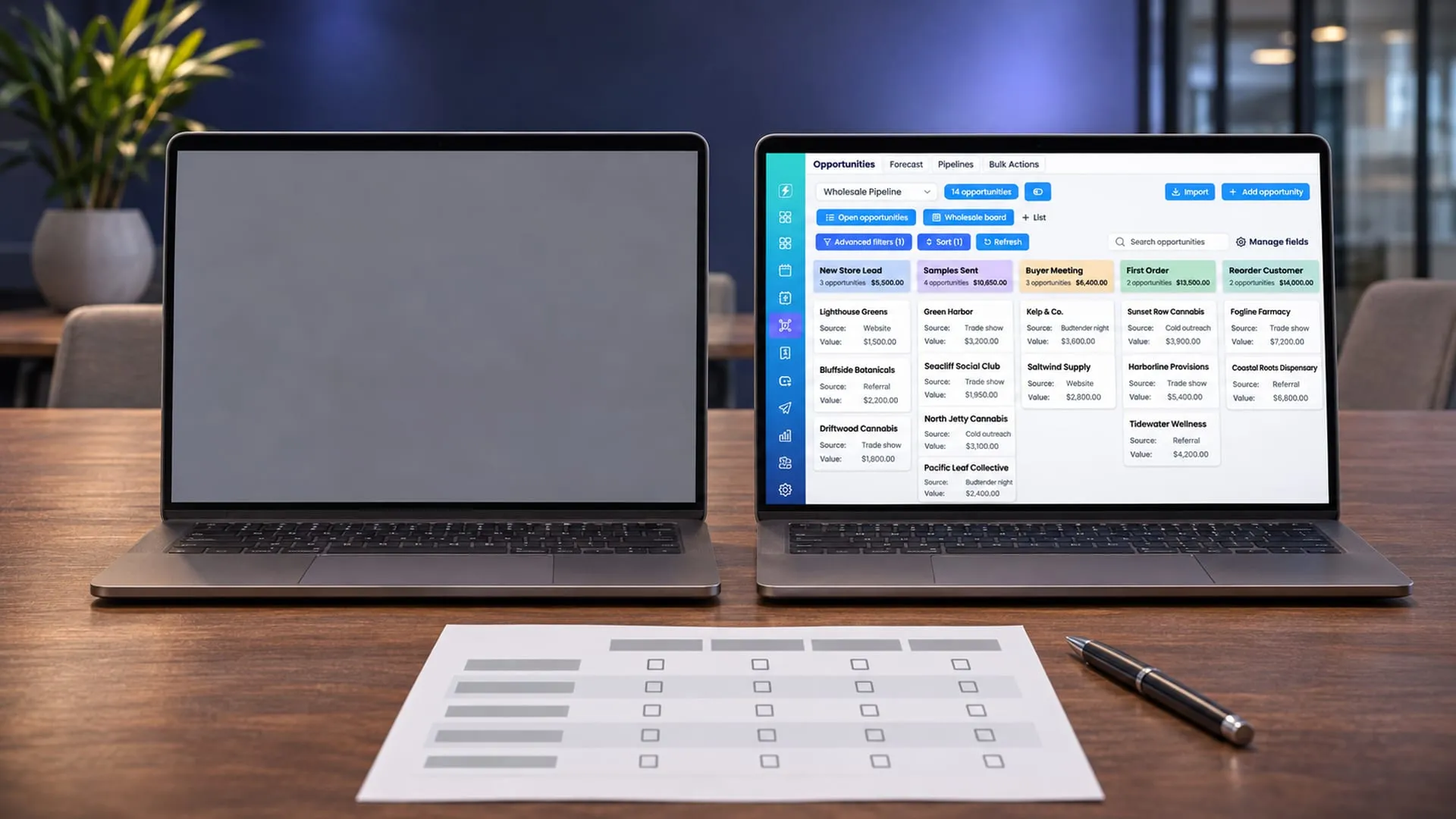
- Schedule check-ins with a workflow. For example, when a deal sits in the Reorder stage for 21 days, email the buyer a stock check and give the rep a task to log the count. Ask AI can build it: type “Build a workflow that emails the buyer a stock check when a deal sits in Reorder for 21 days, then gives the rep a task to log units on hand.” HighDay builds a draft workflow and shows an approval card before it changes anything.
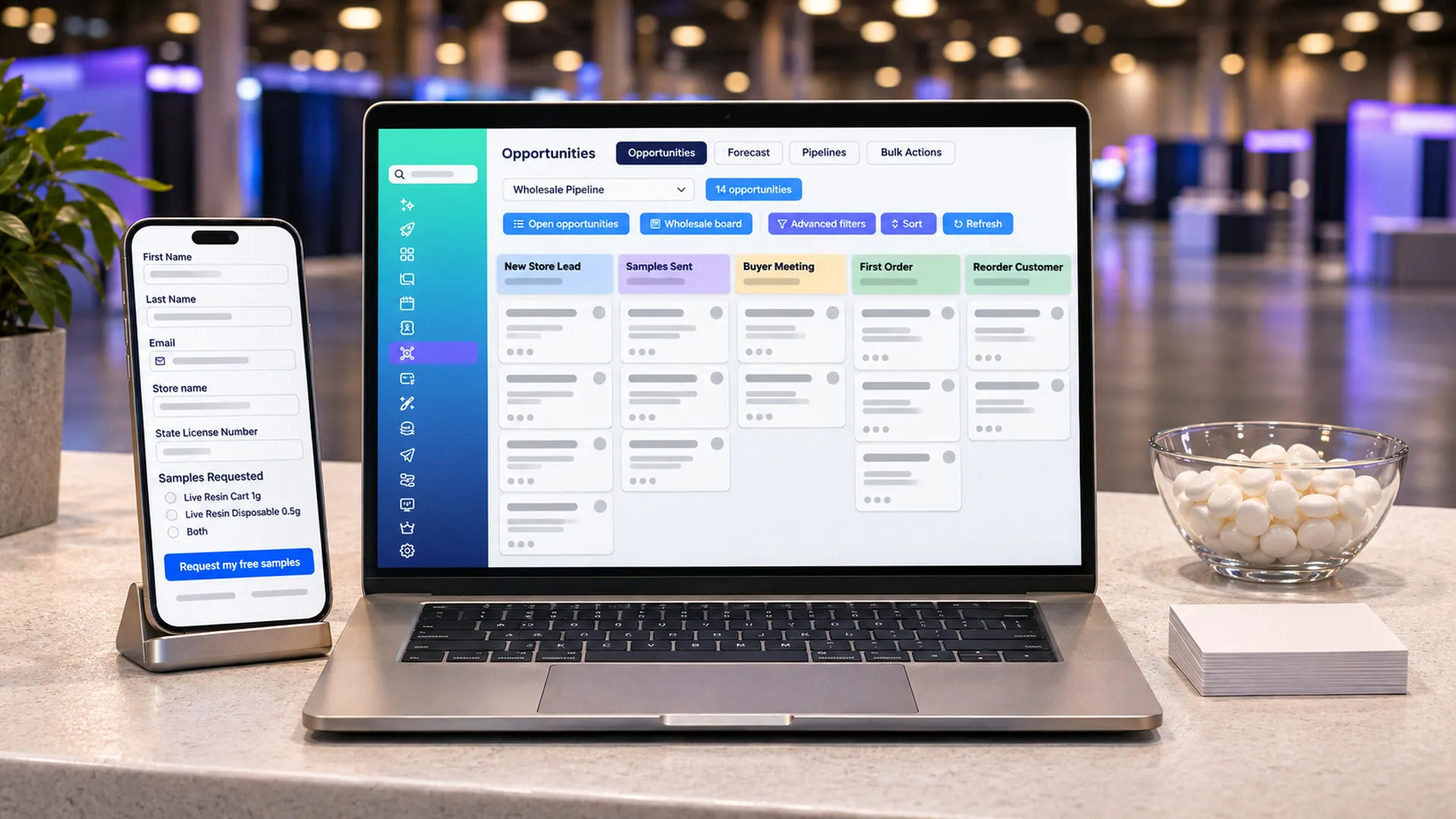
- Collect counts by form. Buyers can send counts through a form or a QR code on your shelf flyer, and the submission can start a workflow.
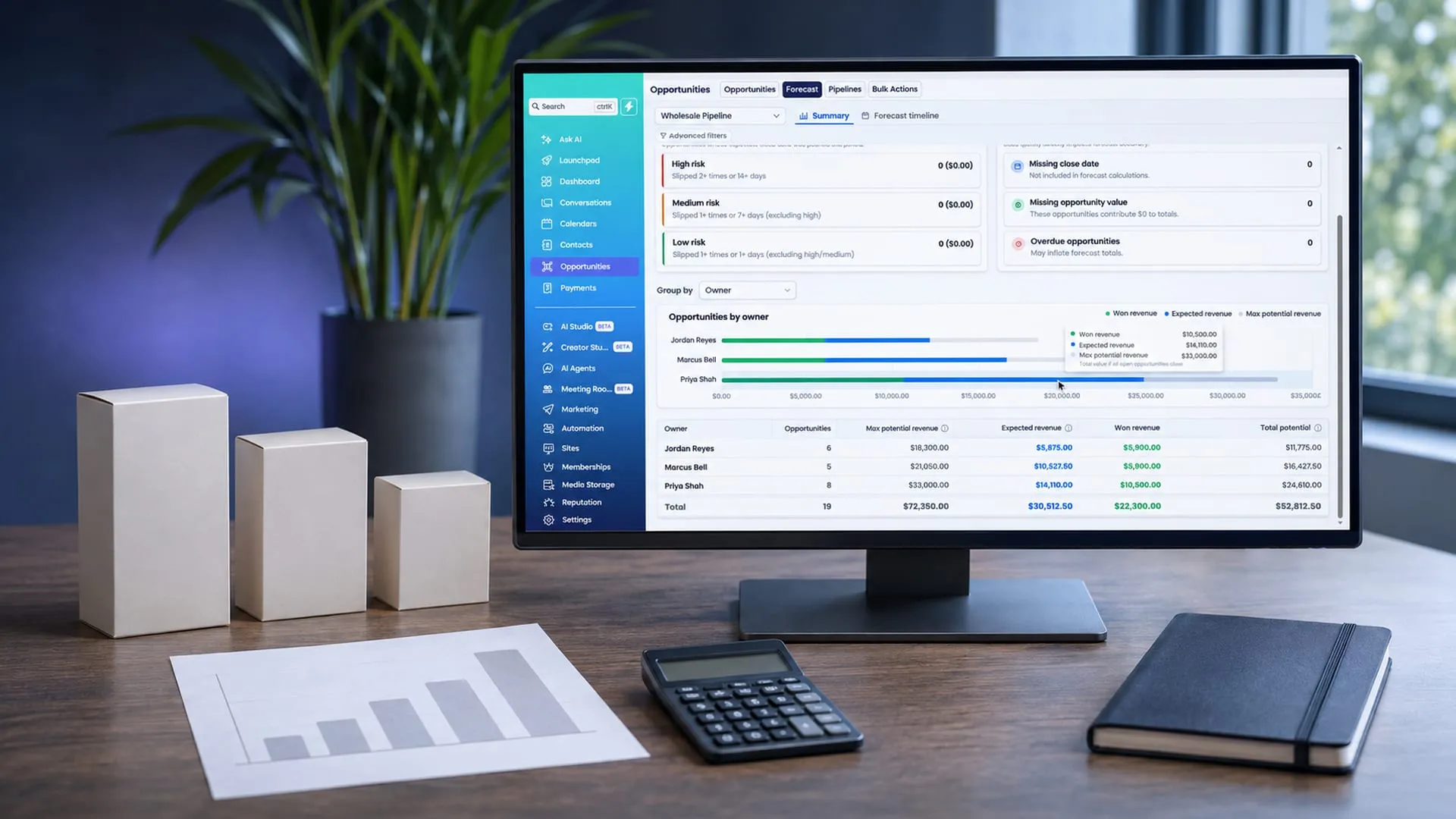
- Review weekly on reporting dashboards and the sales forecast by rep. AI Studio can build an app you describe, for example a sell-through dashboard by store.
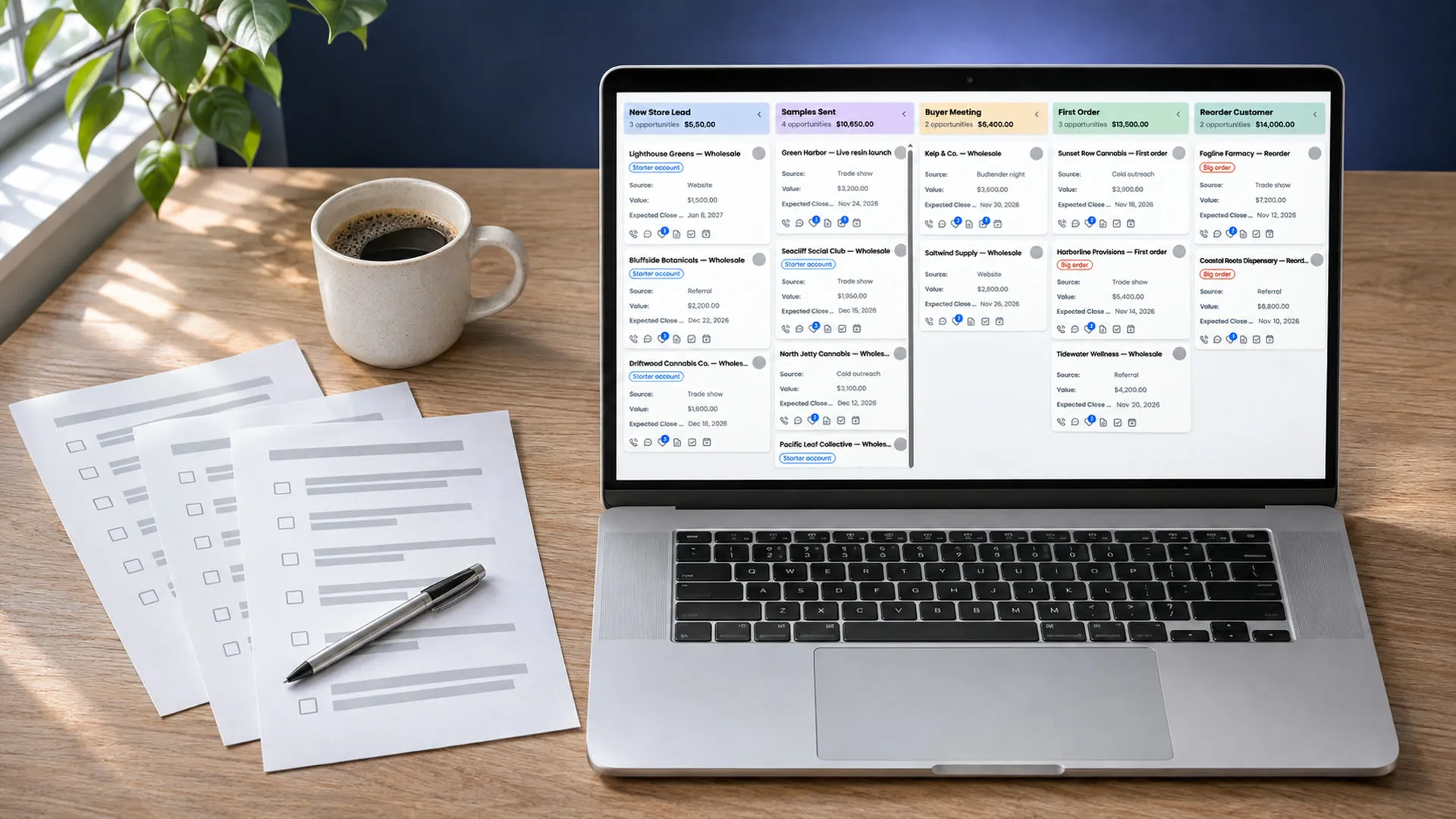
Our post on cannabis wholesale pipeline stages shows where the First Order and Reorder stages fit.
How HighDay helps
HighDay is a cannabis CRM for cannabis and hemp brands, ancillary companies and dispensaries. For sell-through work, a brand team gets:
- Store accounts with a state license number field, and one buyer linked to every store they buy for, with the label Buyer
- Sales pipelines, and workflows with more than 100 triggers and 150 actions
- Forms, QR codes, email campaigns and the AI email writer
- Courses and events for budtender training, and AI Creative Studio for flyers and posts
- Reporting dashboards, a sales forecast by rep, and an iPhone and Android app for reps
- A LeafLink connection that is already in place
Who it isn’t for. HighDay doesn’t come with store sales data. The counts come from your buyers, store reports or a data service you pay for; if that service has an API, HighDay can connect to it when you ask in chat. HighDay is not a dispensary point-of-sale system, does not replace state track-and-trace such as Metrc, and brands cannot text buyers from it. A solo seller with a handful of stores may be fine on a spreadsheet for now.
New to CRMs? Start with what a cannabis CRM does, or see the full platform list.
Try HighDay for 14 days for $4.20. After the trial, the Brands & Ancillary plan is $297 a month plus a $297 one-time setup fee. See plans, watch the demo or book a call.
Frequently asked questions
What is a good sell-through rate for cannabis?
We found no public, primary-source cannabis benchmark as of November 2026. Compare each store with its own last period and with your average across stores.
How do you calculate sell-through rate?
Divide units sold in the period by units available, then multiply by 100. Units available are units on hand at the start plus units received during the period. For example, 150 sold out of 200 available is 75%.
What is the difference between sell-in and sell-through?
Sell-in is what a brand sells to the dispensary. Sell-through is what the dispensary sells to shoppers. Reorders follow sell-through.
How can a cannabis brand get sales data from dispensaries?
Ask the buyer for unit counts at each check-in, ask the store for point-of-sale reports, check its online menu, or pay for a retail data service.
How do you increase sell-through at a dispensary?
Find the cause first. Then train budtenders, run a vendor day, agree on a promo in writing, send the store content, or order smaller amounts more often. Check your state’s rules before you offer anything beyond education.
Can HighDay track sell-through?
Yes, with counts you collect. Keep them on each store account, schedule stock checks with workflows, and review them on dashboards. HighDay does not pull store sales data by itself.