Cannabis CRM: What It Is and What a Brand Needs From One
A cannabis CRM is software that tracks the stores, buyers and deals a cannabis or hemp business sells to, and handles the follow-up. For a brand, that means every dispensary account, every buyer at those stores, every order and reorder, and every budtender training, kept in one place the whole sales team can see.
Most brands start with a spreadsheet and a shared inbox. That holds up until you have a few reps, a few hundred stores and buyers who move between them. Then a reorder slips because nobody saw the store go quiet, or two reps pitch the same buyer in the same week.
This guide covers what a cannabis CRM does, what a brand needs from one, and the one job no CRM will do for you.
The two kinds of cannabis CRM
Cannabis CRMs split by who you sell to.
Brand and wholesale CRMs are for companies that sell to stores: cultivators, processors, brands, distributors, and ancillary companies such as packaging and lab vendors. The customer is a licensed business. The CRM tracks store accounts, buyers, wholesale orders, store visits and reorders.
Retail CRMs are for dispensaries that sell to shoppers. The customer is a person. The CRM tracks purchase history, loyalty and opt-ins for email and text.
HighDay has a plan for each: Brands & Ancillary for companies that sell to stores, and Dispensaries for licensed retail. This guide is about the first kind.
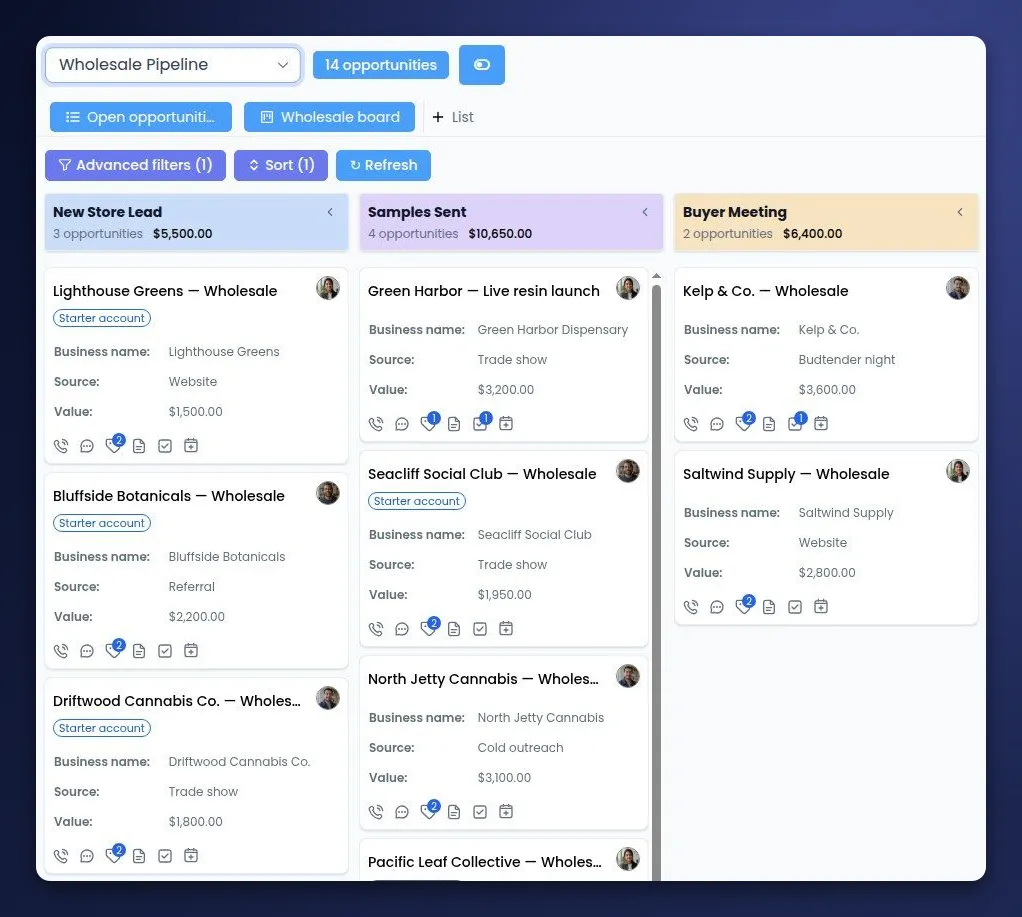
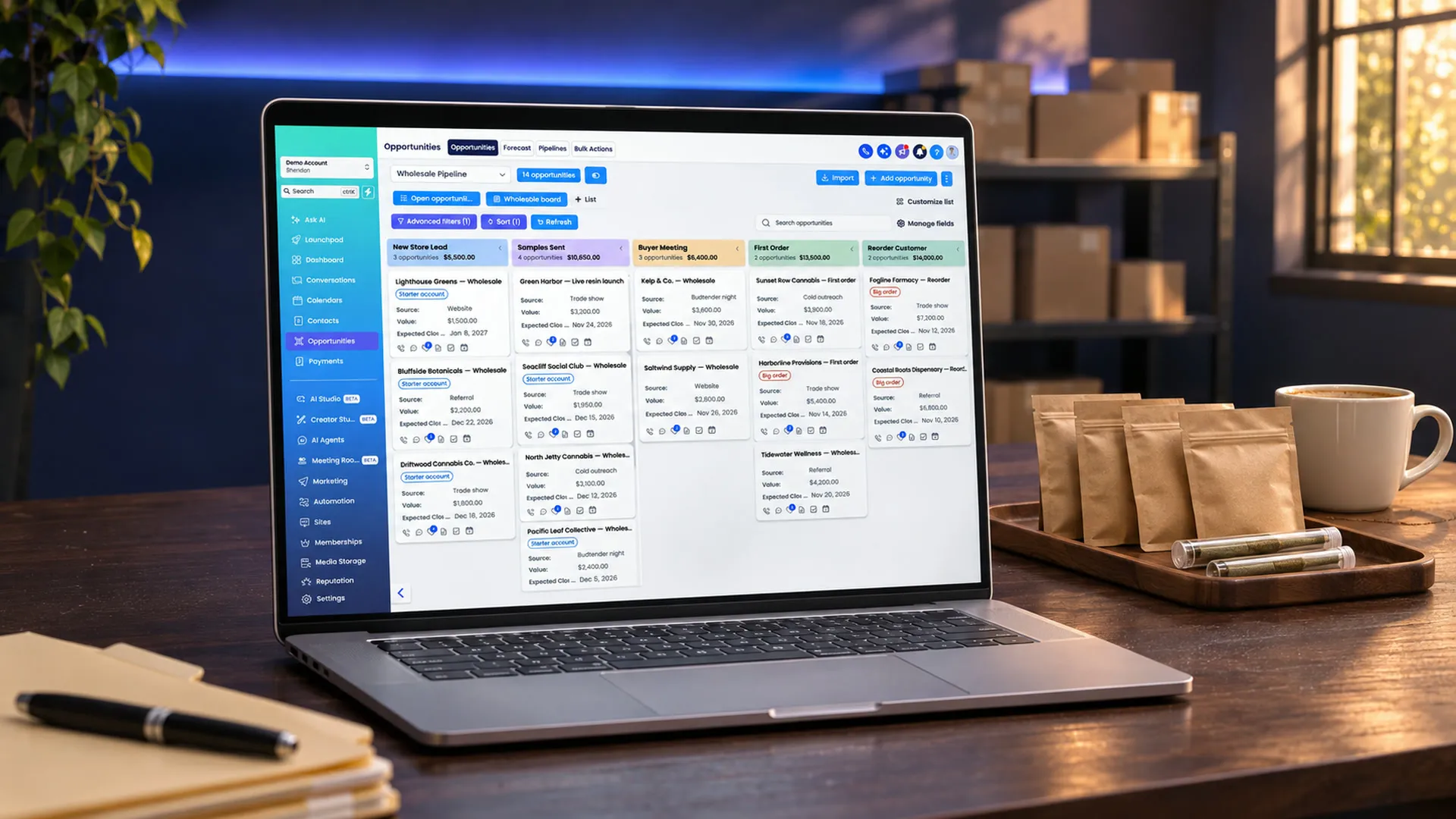
A wholesale pipeline in HighDay. Each column is a stage, and each card is a deal with one store.
What a brand’s CRM has to track
| What to track | Why it matters | How HighDay handles it |
|---|---|---|
| Store accounts | Each dispensary is a business with an address, a license and a buyer. | Company records with fields such as business name and state license number. |
| Buyers | One buyer often buys for several stores. You want one contact, linked to each store. | Link a buyer to every store they buy for, with the label Buyer. |
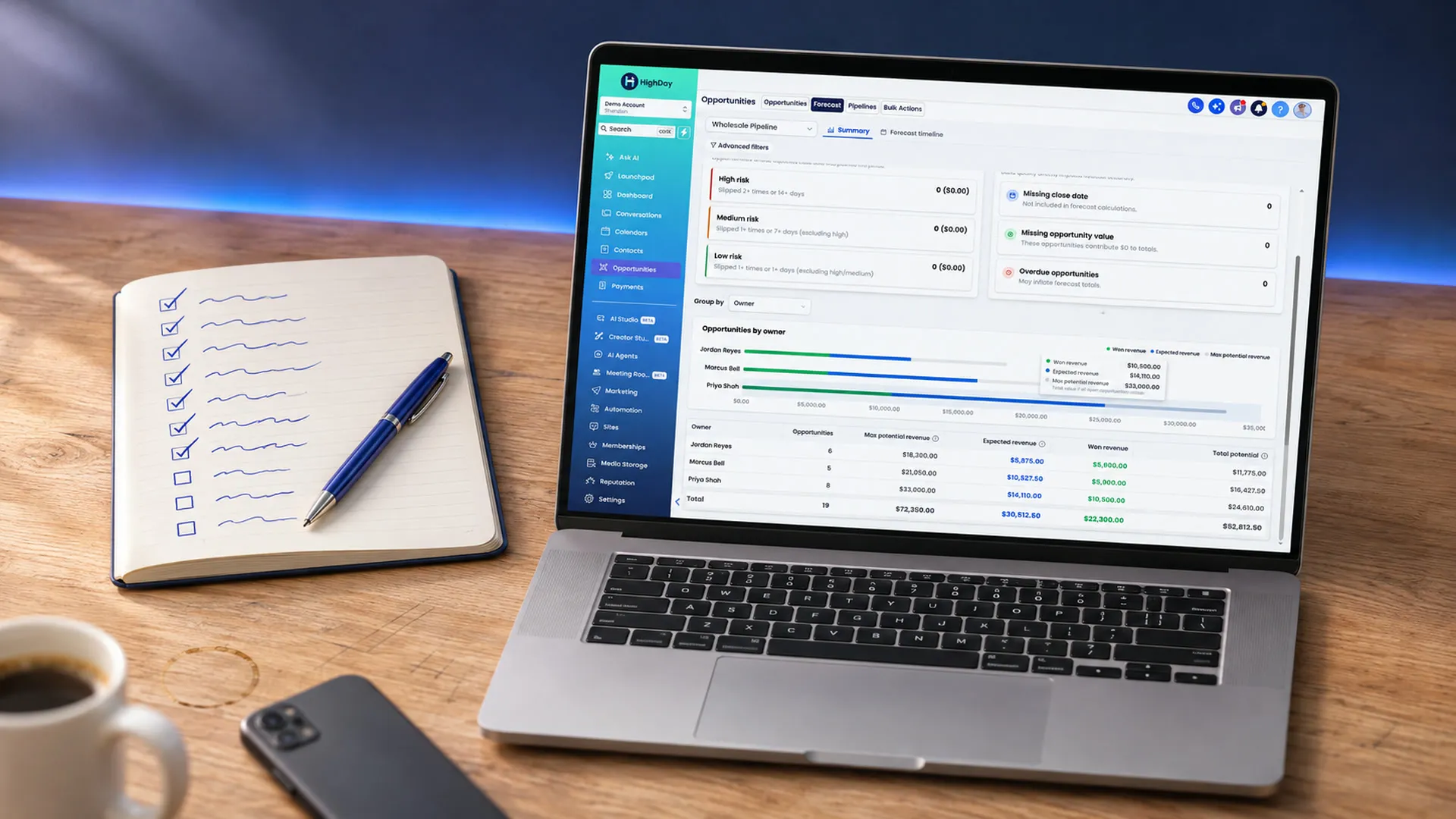
| The pipeline | A store moves from first pitch to samples to first order. Each step needs an owner and a next date. | Sales pipelines with stages you name, and tasks for each rep. |
| Reorders | A store that ordered once is your easiest next sale. | Workflows that email the buyer or remind the rep when a deal sits too long. |
| Trainings and store visits | Budtenders recommend what they know. Trainings and visits are how they get to know you. | Calendars for buyer meetings, store visits and trainings, plus courses and events for budtender training. |
| Wholesale orders | If you sell on a wholesale marketplace, orders belong on the store’s record. | HighDay connects to LeafLink. |
| Content | Buyers and budtenders need sell sheets, launch posts and product photos. | AI Creative Studio makes posts, flyers, logos and short videos. |
If a CRM can’t do the first three rows well, keep looking. Everything else on the list depends on clean store accounts and buyers.
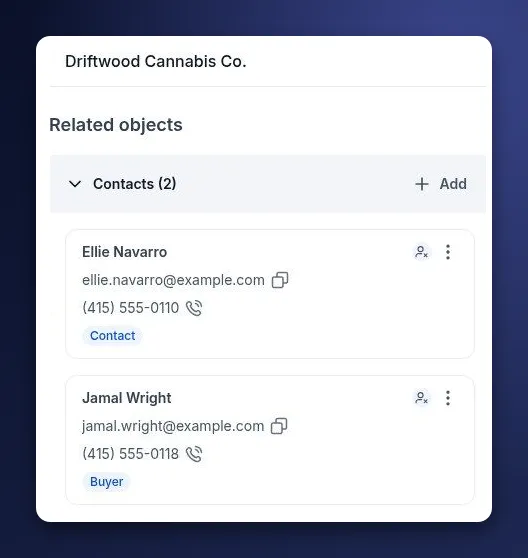
A store account in HighDay with its contacts. The label shows who the buyer is.
The CRM keeps the relationship organized. Winning the shelf space is still up to your team, and our guide on how cannabis brands stand out to dispensaries covers that side.
Why brands outgrow spreadsheets and general CRMs
A spreadsheet has no reminders and no history. It can’t tell a rep that a store hasn’t reordered in 45 days, and it can’t send the follow-up email for them.
General-purpose CRMs work for cannabis, and plenty of brands use them. The friction shows up in three places.
Setup. You build the store accounts, license fields and buyer-to-store links yourself, or pay someone to.
Price as you grow. Many CRMs charge per seat, and some also charge by the number of marketing contacts. Each new rep and each new batch of stores raises the bill. Our HighDay vs HubSpot comparison has the numbers for one well-known example.
Cannabis rules. Some email and texting services limit cannabis and hemp content. Read a vendor’s acceptable use policy before you move your list.
HighDay is built for cannabis and hemp companies. The Brands & Ancillary plan is $297 a month, and it comes with the CRM, email campaigns, automations, invoices, contracts with e-signature, a video meeting room, courses, events and the AI tools covered below. The platform page lists everything in one place.
What a cannabis CRM won’t do
A CRM does not replace your state track-and-trace system. Systems like Metrc track plants and packages for the state. Your CRM tracks relationships and sales. The two should share data, but they do different jobs.
HighDay connects to seed-to-sale and ERP tools such as Canix and GrowFlow, and to any other system with an API or an MCP server. MCP, the Model Context Protocol, is the standard AI assistants like Claude and ChatGPT use to work with other software.
Where AI fits in a cannabis CRM
In many CRMs, AI writes email drafts. In HighDay, you can run the CRM by typing what you want.
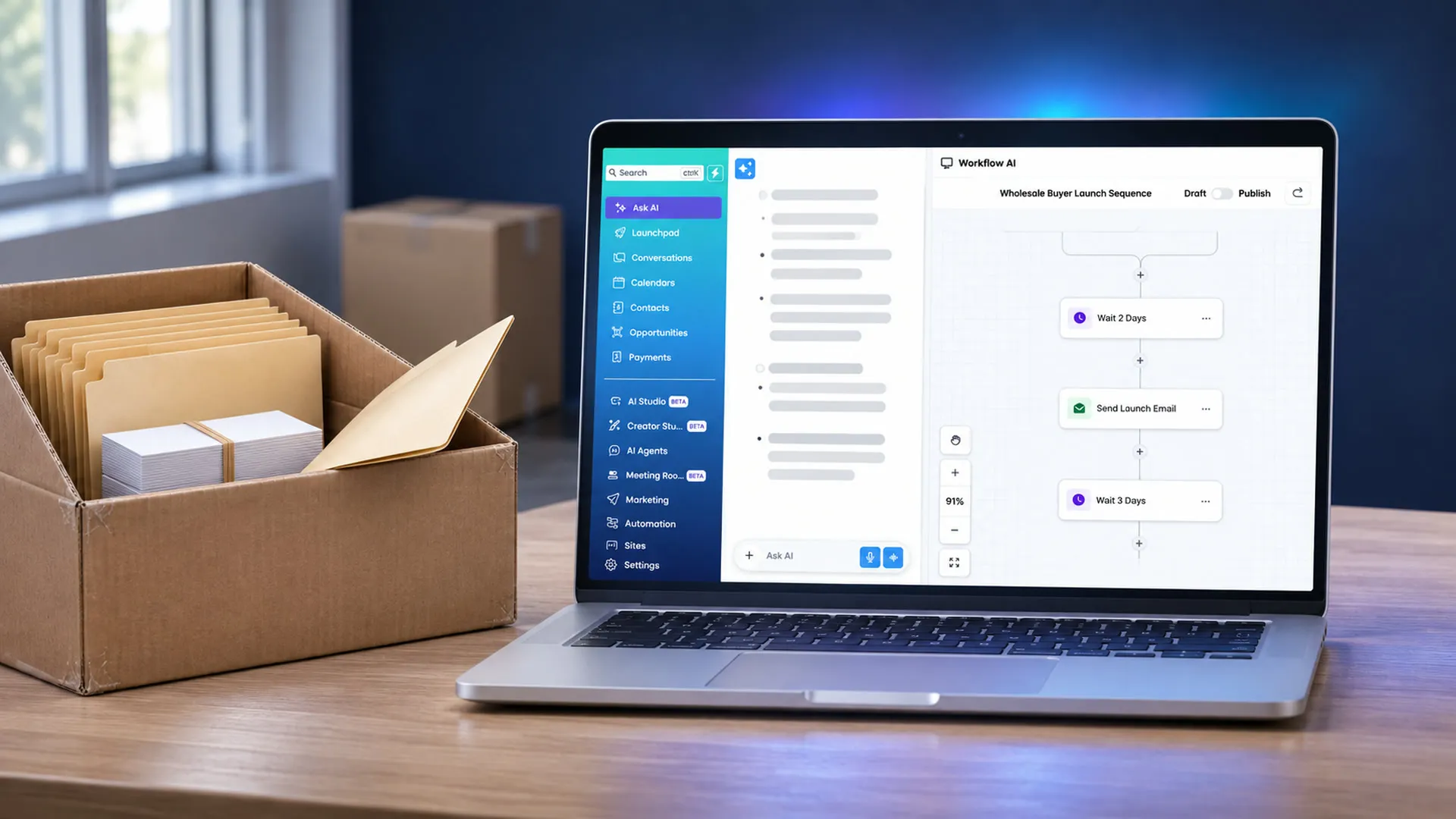
Ask AI. Type a request in plain English, such as: “Add Dana Ruiz as the buyer at our new Boulder account, tag her Colorado, and add a note that she wants samples of the mango gummies.” HighDay shows an approval card before it changes anything. Ask AI can also draft email campaigns and build draft workflows for you to review.
AI Studio. Describe an app and HighDay builds it. A rep check-in app or a reorder dashboard are two examples of what a brand could ask for. AI Studio can also build a brand website with a 21+ age gate and a wholesale signup form.
Connections by chat. HighDay is already connected to LeafLink and CannaSpyglass. It connects to other software with an API or an MCP server when you ask it to in chat.
Claude and ChatGPT. If your team already uses Claude or ChatGPT, connect it to HighDay and work from there.
How to get started
- List what you track today. Stores, buyers, open deals, reorder dates, and who owns each one.
- Clean your spreadsheet. One row per buyer, with columns for store name and license number.
- Import it. HighDay matches some columns by itself. Check each one, and map store name and license number by hand. Coming from HubSpot? Use the HubSpot importer.
- Build the reorder workflow first. For example: when a deal sits in the Ordered stage for 30 days, email the buyer and give the rep a call task.
- Add your reps and install the HighDay app for iPhone or Android, so they can update notes from the road.
Not sure what to look for in a CRM? Use our 10 questions to ask before you choose a cannabis CRM.
Try HighDay for 14 days for $4.20. After the trial, the Brands & Ancillary plan is $297 a month plus a $297 one-time setup fee. See plans, watch the demo or book a call.
Frequently asked questions
What is the best CRM for cannabis brands?
The best one fits how you sell. If you sell to dispensaries, pick a CRM built around store accounts and buyers, with a link to your wholesale platform. Our buyer’s checklist has 10 questions to compare tools.
Can I use HubSpot or Salesforce for a cannabis business?
Yes, and many brands do. You set up the cannabis parts yourself, and per-seat pricing goes up as your team grows. See HighDay vs HubSpot for a side-by-side.
Does a cannabis CRM handle compliance?
No CRM replaces your state track-and-trace system. A good CRM does keep the records that help, such as license numbers on each store and opt-ins on each contact.
Can cannabis brands text their buyers from HighDay?
Not right now. Texting is part of the dispensary plan. Brands and ancillary companies reach buyers by email, chat, social posts and events.
Does HighDay work for hemp and CBD brands?
Yes. Hemp brands, including hemp THC, CBD and beverage brands, are on the Brands & Ancillary plan and get the same tools as cannabis brands.
How much does a cannabis CRM cost?
Prices vary by vendor and by how they count seats and contacts. HighDay’s Brands & Ancillary plan is $297 a month plus a $297 one-time setup fee, after a 14-day trial for $4.20.