CRM for Cannabis Distributors: What to Look For in 2026
A CRM for cannabis distributors tracks both sides of a distribution business: the brands whose products you carry and the dispensaries you sell them to. It should keep every store account and buyer, show which brands each store stocks, flag stores that stop reordering, and help you report back to your brand partners.
This guide is for licensed distributors and wholesalers that carry several brands into many stores. If you sell one brand of your own, start with what a cannabis CRM is and what a brand needs from one.
What does a cannabis distributor do that a CRM has to track?
A cannabis distributor buys from many licensed producers and sells to many licensed stores, so its CRM has to hold supplier brands and retail buyers side by side. A single brand’s CRM only needs the second group.
State rules shape that middle position. New York’s adult-use distributor license overview says distributors may obtain products from licensed cultivators, processors and other licensees and sell them to licensed adult-use retailers. It also says a distributor may not hold any interest in a retail dispensary or sell direct to consumers. In California, the Department of Cannabis Control says a Type 11 distributor can provide storage services to other licensees and arrange for testing of cannabis goods, on top of moving finished goods to retail.
For scale, in its October 2, 2026 release, New York’s Office of Cannabis Management counted 241 licensed adult-use distributors, against 582 processors, 280 cultivators, 548 retail dispensaries and 370 conditional retail dispensaries.
Rules differ by state. This is not legal advice, so check with your attorney and your state regulator.
How is a distributor CRM different from a brand CRM?
A brand sells one catalog, while a distributor sells many brands, so the unit a distributor manages is one brand placed at one store. Your brand partners are customers too.
| Question | A single brand’s CRM | A distributor’s CRM |
|---|---|---|
| Who are the customers? | Stores and their buyers | Stores and buyers, plus every brand you carry |
| What is one deal? | A store’s order | One brand placed at one store |
| What does a reorder alert watch? | Each store | Each store, for each brand it carries |
| Who reads the reports? | The owner and the reps | The owner, the reps and each brand partner |
| What else do you sell? | Nothing | Your service, to brands you want to sign |
The last row is easy to forget when you shop for software. A distributor runs two sales processes at once, one that sells products to stores and one that sells its distribution service to new brands.
Cannabis distributor CRM checklist
The right-hand column shows HighDay’s answer as of November 2026, including the rows where it is no.
| Feature | Why a distributor needs it | HighDay |
|---|---|---|
| Store accounts with license numbers | You can only sell to licensed stores, and license numbers match records across tools | Yes. Company records with a state license number field |
| One buyer across several stores | Multi-store groups often buy for every location | Yes. Link one buyer to every store, with the label Buyer |
| Brand partner accounts | The brands you carry have their own sales, marketing and compliance contacts | Yes. Brands are company records too |
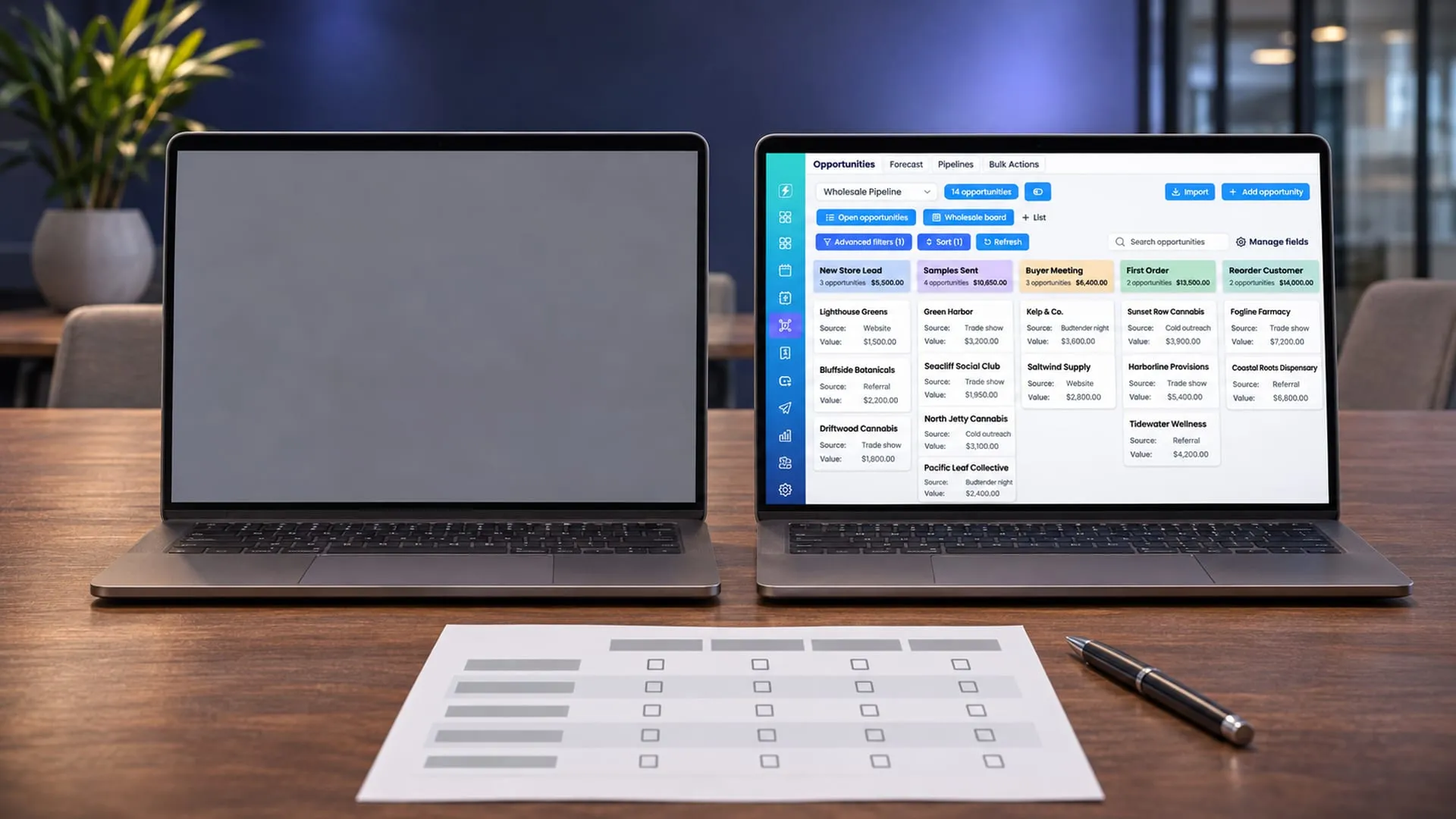
| Brand placement by store | You need to see which stores carry Brand A but not Brand B | Yes, if you give each brand its own sales pipeline, with one deal per store |
| Reorder alerts | A quiet store is lost revenue for you and the brand | Yes. Workflows with triggers such as “deal sits too long in a stage” |
| Rep reporting | You need to see which reps are moving each brand | Yes. Reporting dashboards and a sales forecast by rep |
| Wholesale marketplace connection | Orders and conversations should meet in one place | Yes. HighDay is connected to LeafLink |
| Trainings for the brands you carry | Budtenders sell what they know | Yes. Courses, events with tickets and RSVPs, and Meeting Room video |
| Inventory, manifests and Metrc reporting | Required for compliance | No. Keep these in your ERP or seed-to-sale system |
| Route optimization for drivers or reps | Saves drive time | No. HighDay has no route optimization or GPS |
| Text messages to buyers | Some teams want it | No. Texting is part of the dispensary plan only |
Ask about brand placement by store first, because it is the hardest thing to add after your data is in.
What should stay in your ERP, and what belongs in the CRM?
Inventory, transfers, manifests and state reporting belong in your ERP or seed-to-sale system. Relationships, follow-up, marketing and new business belong in the CRM. A distributor usually needs both, and the two should share data.
Here is what three cannabis ERPs say about their own distribution features (checked November 2026):
- Canix lists a bi-directional Metrc sync, pick lists that create invoices, and contact tools: “Manage multiple contacts per company with custom fields, files, activities, reminders and more.” Canix is a HighDay partner and already connected.
- GrowFlow Wholesale says it can “Automatically generate manifests for each order, including driver information and directions,” and lists a feature to “Reach out to customers who have not purchased recently.” GrowFlow is also a partner and already connected.
- Distru describes itself as “a cannabis ERP with a built-in B2B wholesale marketplace,” used by 450+ operators in 30+ states. Its price is not listed on its site.
On the ordering side, LeafLink says it “connects brands, distributors, and retailers on one platform,” with over 12,000 sellers and buyers across 30 markets. Its integrations page lists Salesforce in its CRM category. Our LeafLink vs Apex Trading comparison covers how the wholesale marketplaces differ.
If your team is small and your ERP’s contact tools already cover your follow-up, you may not need a separate CRM yet. A CRM earns its place when you run email campaigns, trainings and multi-step follow-up while you sign new stores and new brands. For a task-by-task split, see Metrc vs a CRM.
How should a distributor set up its CRM?
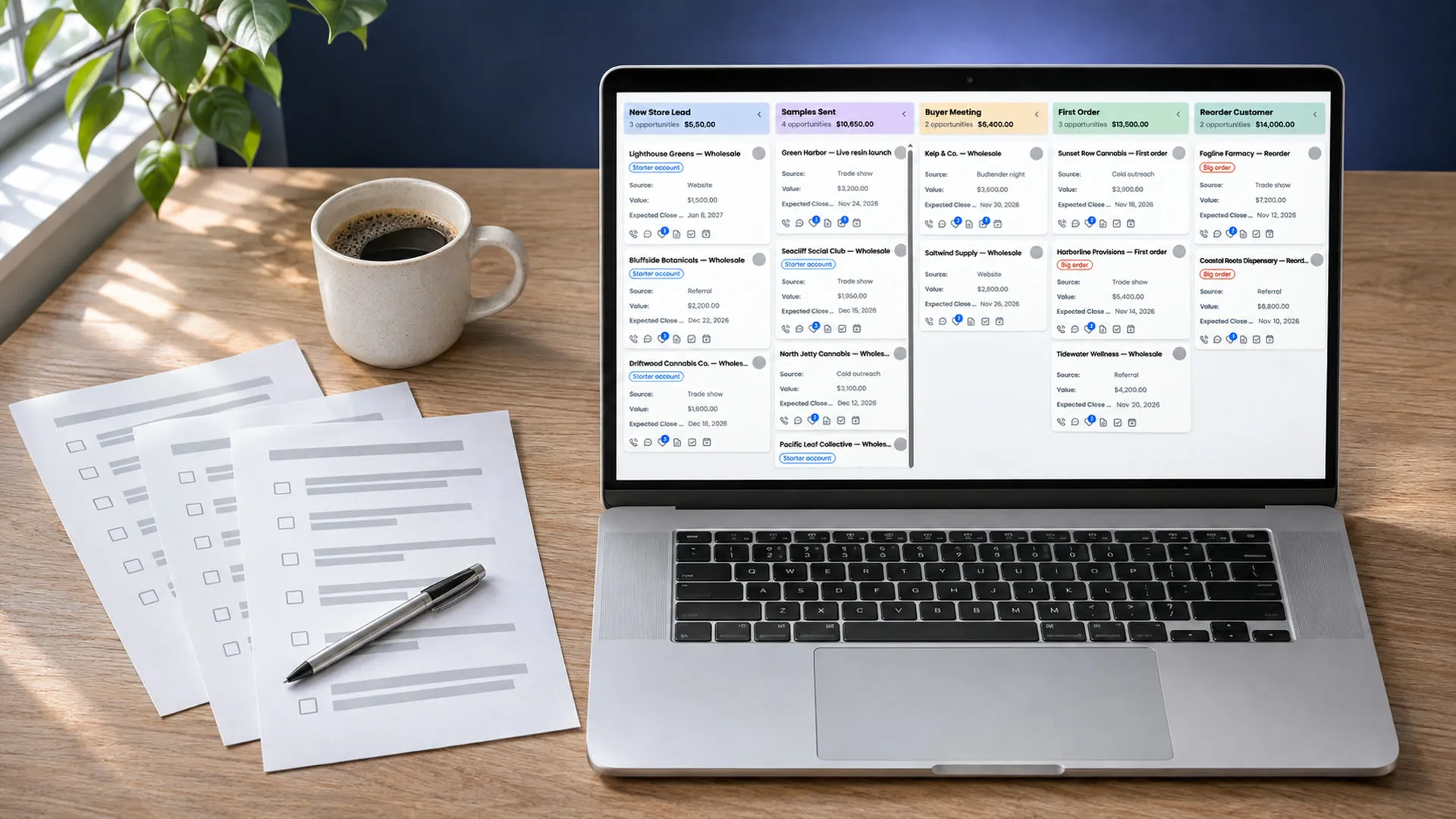
Set up pipelines for placing brands in stores, add one for signing new brands, then add the workflows that watch them.
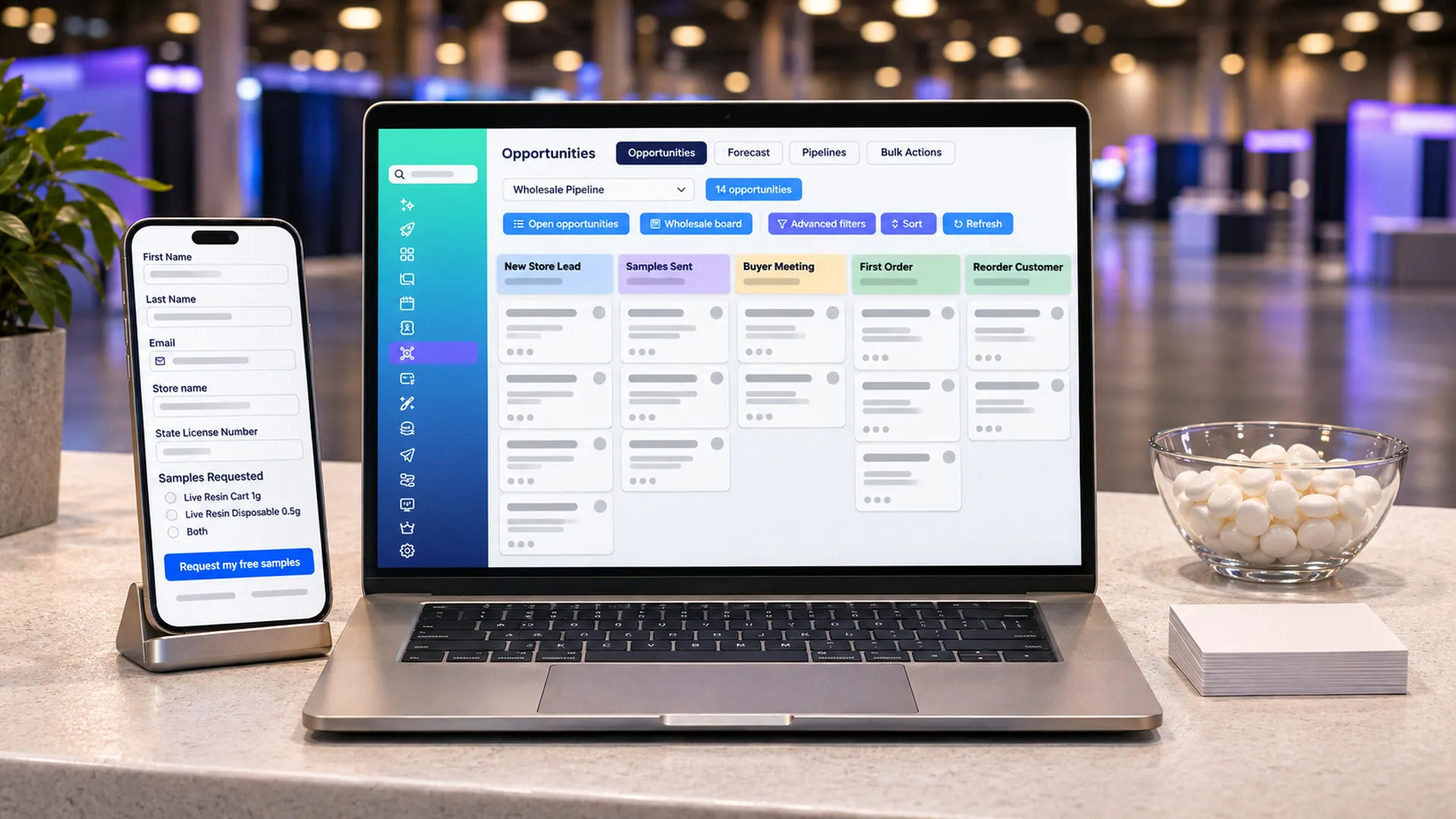
- Import stores and buyers. Map store name to Business Name and license number to State License Number on import. Link each buyer to every store they buy for.
- Add your brand partners as accounts. Put each brand’s sales, marketing and compliance contacts on its record.
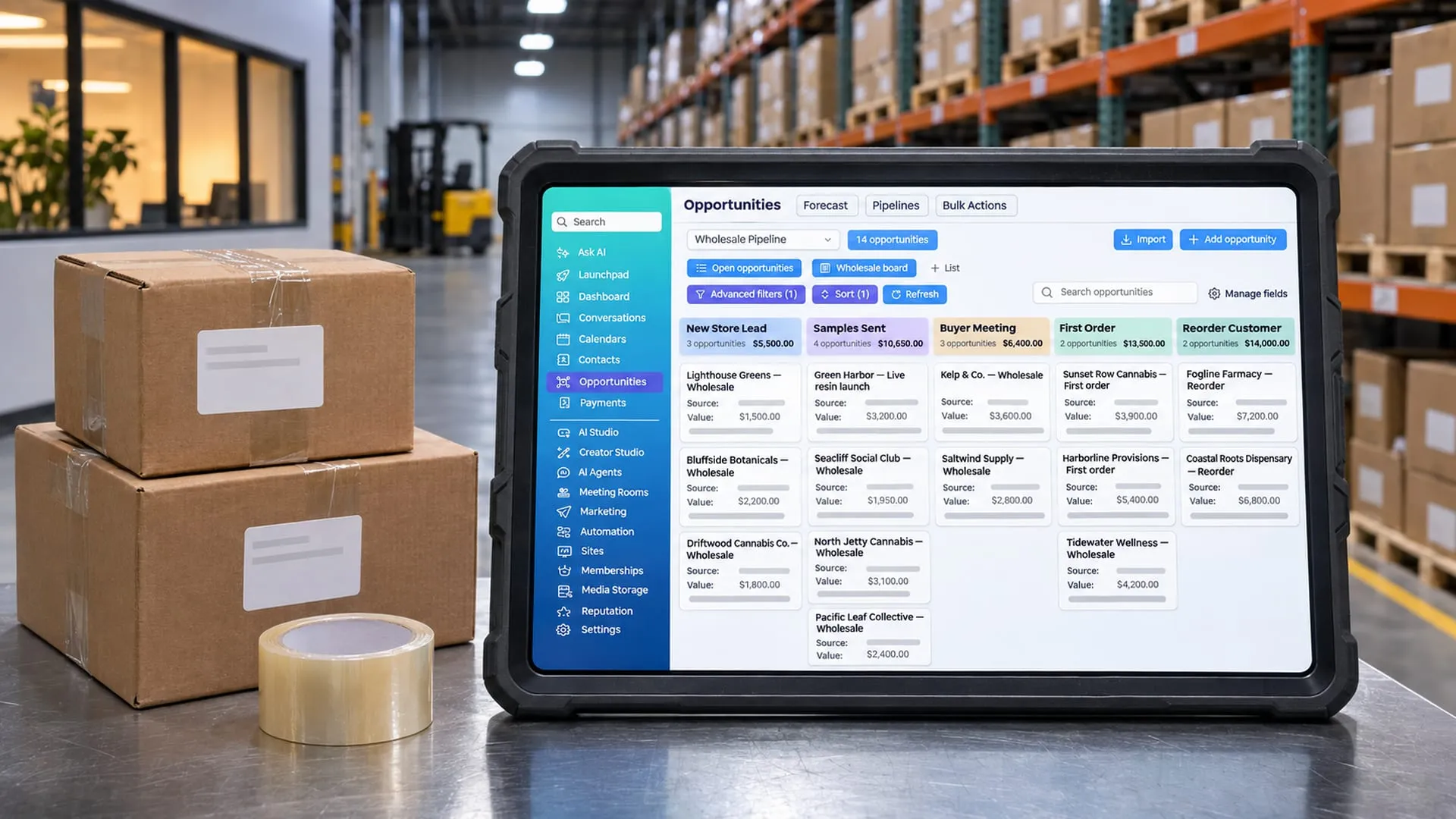
- Build store placement pipelines. Give each brand its own pipeline with one deal per store, and stages you name, for example Pitched, Samples, First Order and Reordering. Our wholesale pipeline stages guide has a stage template.
- Build a brand signing pipeline. For example Brand Lead, Evaluation, Terms Sent, Agreement Signed and Launch. Send the agreement for e-signature from HighDay.
- Add the reorder workflow. When a store’s deal sits in Reordering too long, email the buyer and give the rep a call task. The reorder guide covers timing.
- Put reps on the phone app. The HighDay app for iPhone and Android has contacts, notes and conversations. Plan the drive itself in a map app, as our territory guide explains.
You can also type requests into Ask AI. For example: “Draft an email to every buyer tagged Denver announcing that we now carry Northside Gummies, and build a draft workflow that gives Dana Ruiz a call task three days after it sends.” HighDay shows an approval card before it changes anything.
Watch payment terms as well. New York’s October 2, 2026 release reminded licensed suppliers that delinquent payments on credit transfers made on or after September 15, 2026 should be reported through Metrc. If you don’t invoice from your ERP, HighDay sends invoices and shows what is paid and due. Our wholesale invoicing guide covers terms and follow-up.
Is HighDay a good CRM for a cannabis distributor?
HighDay is a cannabis CRM for cannabis and hemp brands, ancillary companies and dispensaries. Distributors sell to stores, so they use the Brands & Ancillary plan, which is $297 a month plus a $297 one-time setup fee, with 25,000 emails a month and no charge per user or per contact.
A good fit: a distributor with several reps and a growing list of brands that wants store accounts, brand partner records, email campaigns, budtender trainings and follow-up in one place. A flat price helps when you add reps. HighDay connects to LeafLink, Canix and GrowFlow, and to other software with an API or an MCP server when you ask in chat. See the integrations page and the full platform list.
Not a good fit:
- You need inventory, manifests or Metrc reporting from the same system. Use an ERP for that and connect it.
- You need route optimization or GPS tracking for drivers or reps. HighDay doesn’t do either.
- You want to text dispensary buyers. Texting is not part of the Brands & Ancillary plan.
- You have two reps and a short list of stores, and your ERP’s contact tools already cover follow-up.
Try HighDay for 14 days for $4.20. After the trial, the Brands & Ancillary plan is $297 a month plus a $297 one-time setup fee. See plans, watch the demo or book a call.
Frequently asked questions
What is the best CRM for a cannabis distributor?
The best one tracks both the brands you carry and the stores you sell to, shows which brands each store stocks, and connects to your ERP and wholesale marketplace. Compare tools with our buyer’s checklist, and ask each vendor how it tracks brand placement by store.
Can a CRM replace a distributor’s ERP or Metrc?
No. Inventory, transfers, manifests and state reporting stay in your ERP or seed-to-sale system. The CRM handles buyers, brand partners, follow-up and marketing. HighDay does not replace Metrc.
How do I track which brands each dispensary carries?
Give each brand its own sales pipeline, with one deal per store. Each board then shows every store that carries the brand and where it stands. Compare a brand’s board with your full store list, and the stores that are missing become your reps’ next pitch list.
Does HighDay connect to LeafLink?
Yes. HighDay is already connected to LeafLink, the wholesale marketplace. It is also connected to Canix, GrowFlow and CannaSpyglass.
Can a distributor text dispensary buyers from HighDay?
Not as of November 2026. Texting is part of the dispensary plan only. Distributors reach buyers by email, chat, social posts, video meetings and events.